

Across oceans and cultures, your greatest adventure deserves a breathtaking beginning.
Let the soul of Japan be the witness to your sacred vows.
Dreaming of a shrine wedding in Japan?
For one couple from Germany, it meant no crowd, no reception, no applause —
only the shrine, the trees, and each other. This is the story of the day they became husband and wife in the quiet heart of Japan.
Couple
Nuremberg, Germany
Ceremony
Season
Reading time
They live in Nuremberg, Germany. The bride is 31. The groom is 38 — an engineer with a genuine love for sports cars, the kind of person whose eyes light up the moment the conversation turns to his latest drive.
Both of them share something else, too: a deep fascination with Japan. They love its traditions and its shrines. They love its quiet aesthetics just as much as its pop culture.
Maybe it started years ago. A photograph of a bride in a kimono, glimpsed online. A documentary about a mountain shrine, watched late one night. A phrase of Japanese, picked up from a favorite film and never quite forgotten. Whatever the spark was, it grew — until neither of them wanted to keep waiting for a shrine wedding in Japan of their own.
That someday finally arrived in March. The couple spent months planning a long journey across the country. They pored over train timetables. They bookmarked small inns. They traced a route from city to countryside and back again, with much of the itinerary shaped with the help of Honey J Tours.
Guidebooks piled up on their coffee table at home, pages folded down, margins filled with notes. But underneath all that logistics sat one simple wish — a wish they’d both been carrying quietly, for longer than either had admitted to the other.
Not a large reception. Not a crowd of guests. Just the two of us, quietly exchanging vows.
They didn’t want to skip celebrating. They just wanted to celebrate differently. Instead of well-wishers, place cards, and a microphone passed table to table, they imagined something smaller — and in its own way, larger.
A wedding held in intimate stillness. Just the two of them, watched over by Japan itself. No speeches to prepare, no seating chart to argue over — only a shrine, a season, and each other. Once they said that out loud to one another, it felt obviously right, so they entrusted that vision to Honey J Wedding.
Long before either of them set foot in Japan, that vision took shape over a series of quiet video calls. They sat in their apartment in Nuremberg, evening light on one side of the screen, while the Honey J Wedding team greeted them from morning light on the other.
It felt almost disarming: planning a shrine wedding in Japan from a laptop propped on a kitchen table, half a world away from the shrine itself. Together, they worked out what “just the two of us” actually meant in practice. They wanted no guests to seat, but still a full and proper ceremony. They wanted a date flexible enough to bend around the rest of their itinerary. And they wanted a shrine quiet enough to feel like it belonged only to them for the afternoon.
Photographs went back and forth during those calls — shrines shaded by different trees in different seasons, close-up shots of shiromuku and iro-uchikake so the bride could picture fabrics she’d never touched in person. Together, they sketched a rough shape for the day, hour by hour. Small questions came up on both sides, and each one got a patient answer.
Among the candidates the Honey J Wedding team suggested, one shrine stood out: Oasahiko Shrine, in Naruto, Tokushima. The couple hadn’t found it on their own. It was simply one option among several — until they learned its history.
Within the shrine’s wooded precinct stands the German Bridge. German prisoners of war, held nearby during the First World War, built it themselves. Their Japanese captors treated them with unusual humanity, and the men left behind more than a bridge — they left a quiet legacy of goodwill still remembered in the area today.
For a couple from Germany, that discovery felt like more than coincidence. A small, century-old thread already connected their home to this patch of Japanese forest. In truth, though, they hadn’t found that thread themselves — someone at Honey J Wedding had simply thought to mention it.
By the time the last call ended, the ceremony was still weeks away. Even so, it no longer felt like a plan on a screen. It felt, already, like something that belonged to them. It was, in every sense, the shrine wedding in Japan they hadn’t known to ask for.
At 10:00 that morning, the wedding team began arriving one by one. Two dressing specialists, a photographer, a videographer, and a hair and makeup artist all stepped onto the still-quiet shrine grounds.
Cases opened with the quiet efficiency of people who’d done this many times before, yet never quite the same way twice. Combs and pins lined up in careful rows. A low murmur of last-minute checks filled the room. Every shrine wedding in Japan has its own rhythm, and this one found its footing early, in the quiet choreography of the dressing room.
By 11:00, the couple’s preparation had begun. Layer by layer, the bride’s pure white shiromuku settled into place. Few words passed between them, but a shared glance in the mirror filled the room with warmth on its own.
There was a particular kind of quiet to it: silk rustling into position, an obi tied just so, instructions gently translated across the language gap. Meanwhile, the groom, dressed in his own formal attire next door, kept glancing toward the doorway — half-nervous, half-unable to stop smiling.
Neither of them had worn anything like this before, and it showed. The bride held her arms carefully as the layers settled. The groom adjusted, a little unsteadily, to the weight and structure of his robes. But with every practiced gesture from the team, that unfamiliarity eased.
Small jokes started crossing the language barrier. Someone complimented someone else’s technique with hair pins, and everyone laughed a little too long at the translation. By the time preparations wrapped up, the strangers from that morning already felt like old friends — the kind you make once, on the best day of your life, and remember forever after.
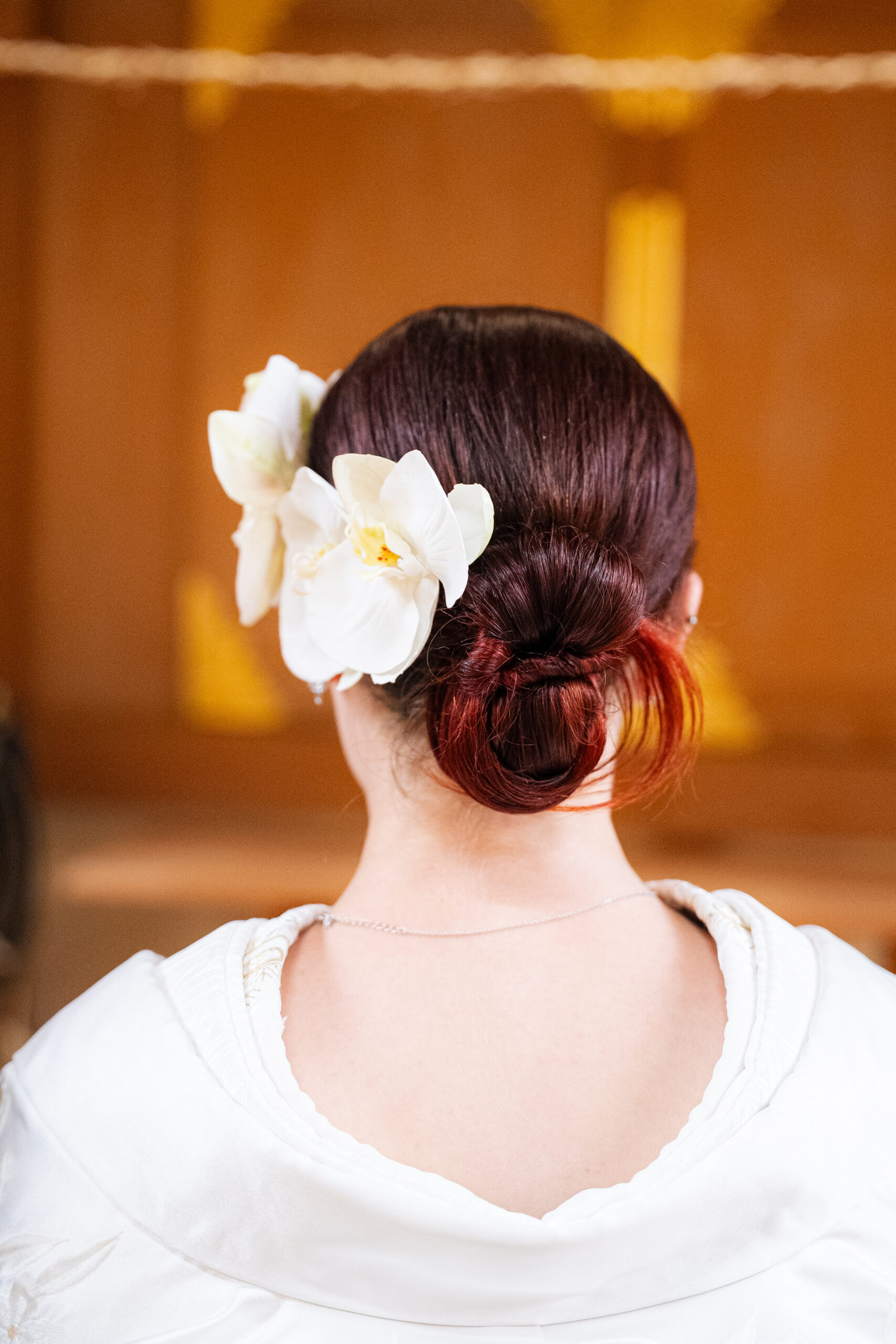
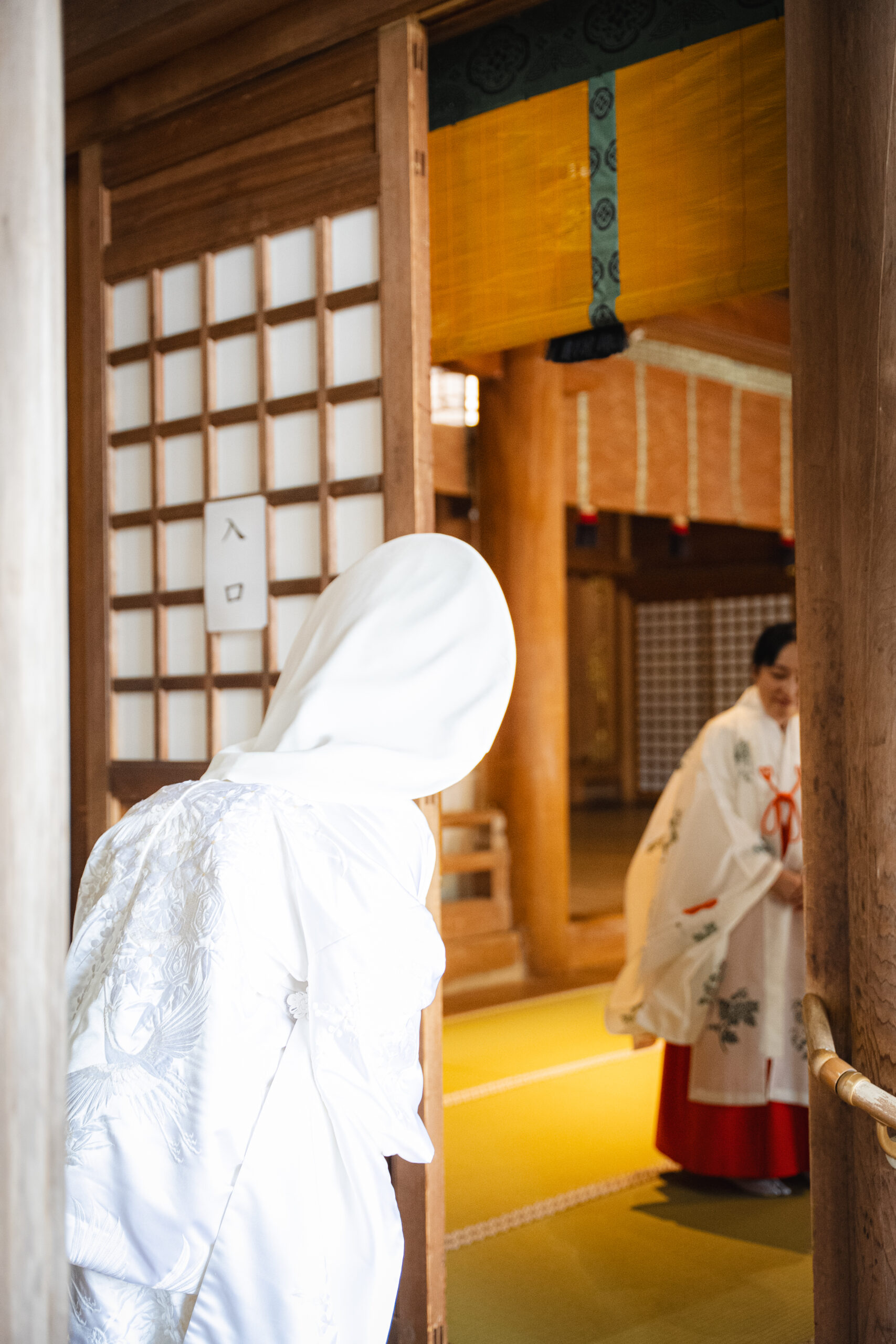
At 2:00 that afternoon, a gentle tension settled over the shrine grounds. This was the moment their shrine wedding in Japan had been building toward all along. Whatever nervous energy had filled the dressing room that morning had softened into something steadier by now — the calm that comes right before a moment you’ve waited a long time for.
The ceremony unfolded in careful sequence. First came the purification rite. Then the priest’s prayer rose and fell in a cadence neither of them could translate, but both could feel. Finally, they read their wedding vows aloud.
Even without understanding every word, the couple seemed to understand something completely: the weight of silence between phrases, the way the whole shrine seemed to lean in and listen. Gravel crunched underfoot as they moved through each stage. Somewhere above them, the trees stirred faintly, as if the wind itself had been invited to witness.
Next came the san-san-kudo rite — three cups, sipped three times each, nine sips in total. As they exchanged the ceremonial cups of sake, their hands may have trembled slightly. That wasn’t doubt; it was the sheer significance of what each small sip represented.
It’s a slow ritual, deliberately so. It’s built to make two people pause and feel the size of the promise they’re making. When they exchanged rings next, a shared glance passed between them — brief, but unmistakable. Everyone present could feel the air around the shrine soften, as if the ceremony’s formality had given way, for just a second, to something entirely personal.
There was no applause. No cheering crowd. No clatter of chairs as guests rose to their feet. Only the two of them remained, standing before the shrine itself — a witness that has watched over countless couples before them.
After the ceremony, the bride changed out of her pure white shiromuku. In its place came a vividly colored iro-uchikake — deep reds and gold thread catching the afternoon light as she stepped back onto the shrine grounds. Against the quiet greens and browns around her, the color felt almost startling, in the best possible way.
The photographer moved quickly, yet unhurriedly. Between the formal shots, small unposed moments kept slipping through: a laugh caught mid-breath, the groom reaching instinctively to steady his new wife’s sleeve as she navigated a step. For a few seconds at a time, the couple forgot the camera entirely.
No two shrine weddings in Japan unfold quite the same way, and this one had something extra woven in — something the couple wouldn’t discover until much later. As far as they knew, the day’s remaining schedule was simply photography and video, nothing more.
But behind the scenes, the videographer had been capturing more than standard coverage. Quietly, without a word to the couple, the wedding team had begun putting together something else entirely: a short film, cut together from footage of the ceremony itself. Neither the bride nor the groom had any idea it existed. As far as they were concerned, the day simply ended the way any wedding day does — full, tiring, and complete.
At 4:00 that afternoon, the day’s schedule came to a close. As the team saw them off, someone offered a simple, warm send-off — a reminder to take care on the road ahead as they continued the rest of their long-planned journey. It was the kind of thing you might say to family setting off on a trip of their own. And it landed exactly that way.
Weeks later, back home in Nuremberg, an official document arrived by mail. The envelope looked quiet and unassuming, yet it carried the weight of everything that had happened that afternoon at the shrine. It felt less like paperwork and more like a keepsake — something two people would find again, years from now, still remembering exactly how it felt to open it the first time.
Around that same time, a message arrived from Honey J Wedding — a link to their finished wedding data. They expected photographs. They did not expect what came with them: a short film, quietly edited from footage of their own ceremony, that neither of them had known existed until that moment.
They sat down together and pressed play. On screen, they saw themselves exactly as they’d been that afternoon in Tokushima — nervous during preparation, solemn while reading their vows, softly smiling as they exchanged rings. It wasn’t a polished, distant wedding video meant for a big audience. It was intimate. It was immediate. And it had been made only for the two of them, without either of them ever suspecting it.
Watching it for the first time, both of them found themselves in tears. They lost all track of time, wrapped up in that unexpected gift.
What struck them most, they later said, wasn’t just the film itself. It was the realization behind it — a team of people who’d spent their own precious minutes that day, between their actual jobs, quietly building something meant purely to make two strangers feel less far from home. Weeks later, on an ordinary evening back in Nuremberg, that quiet effort finally caught up with them.
A day neither of them expected
Where a quiet ceremony became a memory they’ll carry for the rest of their lives.
Carrying the photographs from that day, along with the film they’d only just discovered themselves, the couple sat down with their families and shared the news properly for the first time. Images played across the screen: the shiromuku, the iro-uchikake, the hush of the shrine, their own tearful, smiling faces watching a film they hadn’t known existed. Their families were overjoyed right along with them, asking questions, replaying favorite moments, already talking about a trip of their own to see it all in person one day.
For the rest of their trip, the couple continued through Japan much as they’d planned — a journey Honey J Tours had helped shape long before the wedding itself, carrying them from the shrine in Tokushima onward into the rest of the country they’d been dreaming about for years.
Choosing a shrine wedding in Japan with no guests was never a quiet compromise. It was never a smaller version of something bigger they couldn’t have. If anything, it became something more intimate than a crowded reception ever could — one single afternoon, entirely their own, etched into memory with a clarity that only comes from having nowhere else to look but at each other.
Written by

Thinking about your own shrine wedding in Japan? Honey J Wedding designs intimate ceremonies and private photography for couples traveling from anywhere in the world.